
Start with an actual option chain
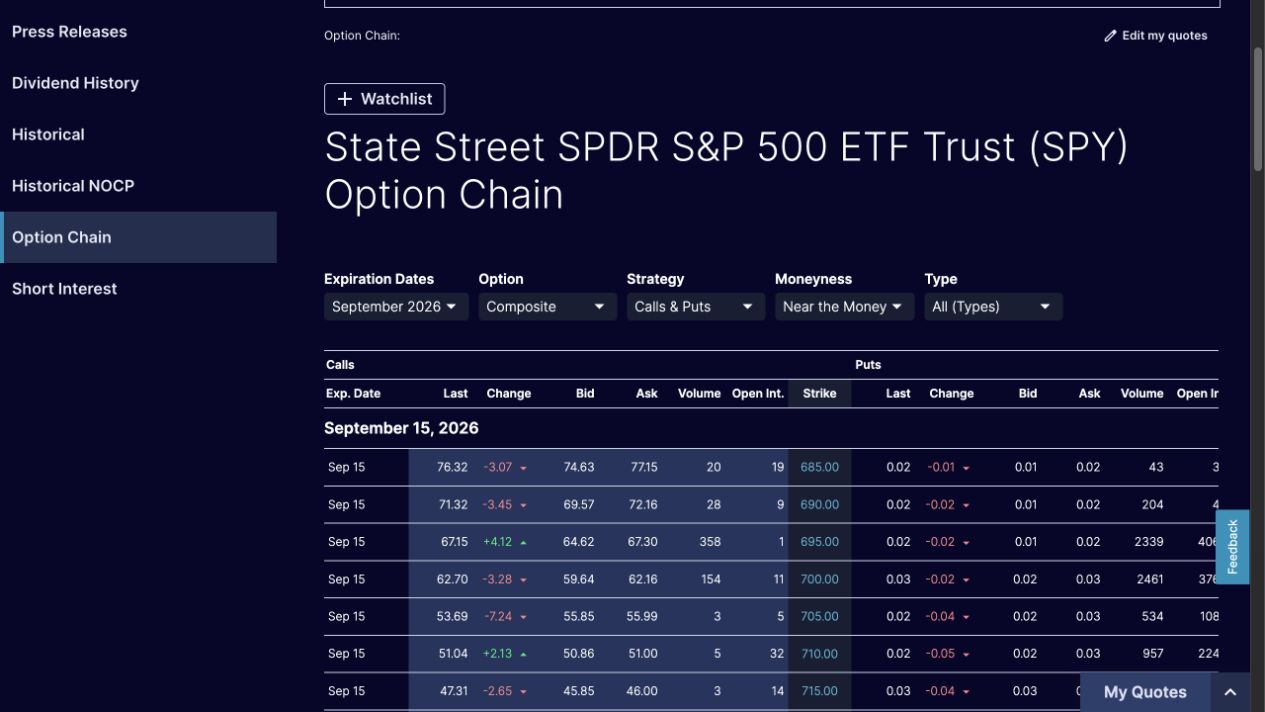
Nasdaq SPY option chain, captured September 15, 2026 before the U.S. cash-market open. The page reports SPY at $760.88, as of September 14, with the market closed. These are displayed market-data snapshots, not live offers.
Read the table from the middle outward. Strike sits between calls on the left and puts on the right. Each row pairs a call and a put with the same strike and expiration. Changing the expiration selects a different contract; changing the strike does too.
The September filter contains several actual expiration dates. The month in the dropdown is not the expiration of every row.
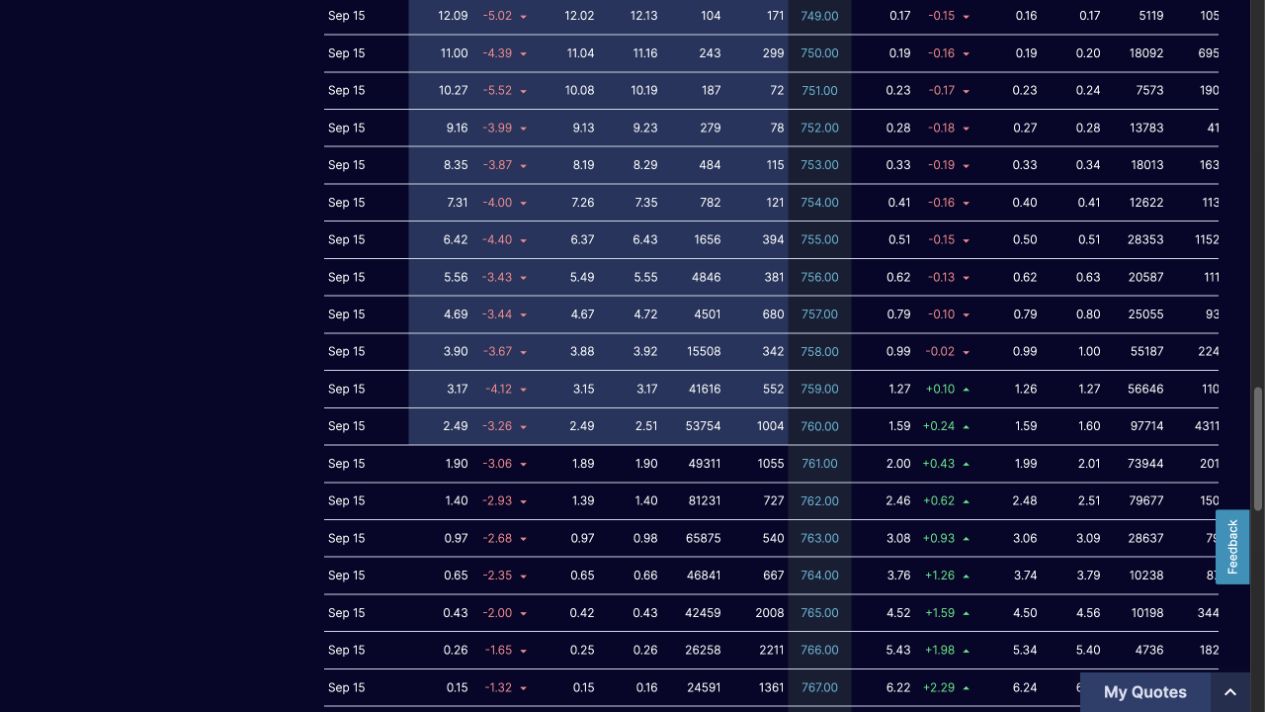
Continuation of the same table. Columns on each side remain Last, Change, Bid, Ask, Volume, and Open Interest. The 760 row is the main example below.
| Field | September 15, 760 Call |
|---|---|
| Underlying | SPY, an ETF |
| Expiration | September 15, 2026 |
| Strike | $760 |
| Call | The holder has the right to buy SPY at the strike; a put gives the right to sell |
| Last | $2.49 per share: the most recently reported trade |
| Bid / ask | $2.49 / $2.51 per share in this snapshot |
| Volume / open interest | 53,754 contracts traded / 1,004 outstanding contracts reported |
The compact contract code is SPY260915C00760000: SPY, September 15, 2026, call, $760 strike. The final eight digits encode the strike in thousandths.
Strike price and exercise price are synonyms. They specify the price of the underlying transaction when the option is exercised.
For this standard SPY call, one contract represents 100 shares. A purchase at $2.49 would cost $249, before fees. Exercising would require a separate $76,000 payment for the shares. The premium is the price of the right; it is not a deposit deducted from the exercise payment.
The contract does not determine whether its owner is long or short. Buying to open creates a long position; selling to close removes it. Selling to open creates the writer’s obligation; buying to close removes that short position before assignment. Simply saying “sell a call” leaves this distinction unresolved.
Expiration: how much time does the idea need?
The book explains traditional monthly cycles. For SPY, selecting an expiration now requires more than knowing the monthly cycle. The Nasdaq month filter groups multiple dated contracts; the date on the individual row is what matters.
SPY has expirations throughout a normal trading week. Tuesday and Thursday expirations were added in 2022, completing the weekday schedule. This is product-specific; it should not be assumed for every stock. Cboe listing notice
0DTE describes the remaining life, not a separate kind of option. A contract bought earlier becomes a zero-days-to-expiration option on its final day. Cboe: 0DTE overview
The September 15 contract is on its final day when these screenshots are captured. The quotes still refer to the preceding session: the observation date and the quote date are separate facts.
Suppose the expectation is that SPY will rise over the next month. A call expiring this afternoon gives that expectation only hours to work. The forecast may eventually be correct while the option expires worthless.
A scheduled announcement makes the choice more concrete: an expiration before the announcement cannot capture the subsequent move; one after it can. The relevant question is which events and potential movements the contract includes—not simply which premium is smallest.
Option value: what is already there, and what is still possible?
Call intrinsic value = max(stock price − strike, 0)
Put intrinsic value = max(strike − stock price, 0)
Time value = option premium − intrinsic value
A call is in the money when the stock is above its strike. A put is in the money when the stock is below its strike. Neither statement says whether the trade has made money.
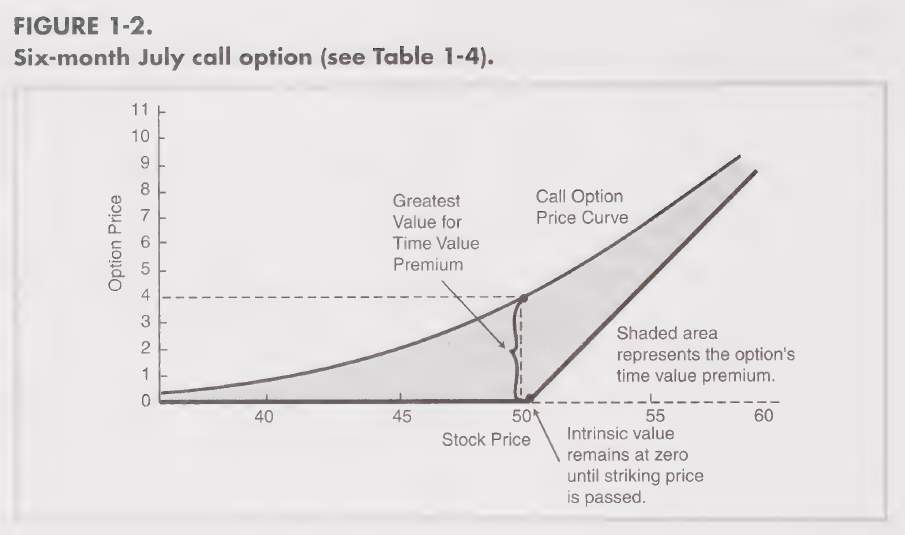
The lower, bent line is intrinsic value. The curved line is the option’s price before expiration. At any fixed stock price, the vertical gap is time value. Near the strike, that gap is largest in the illustration.
The curve is not a forecast of the stock’s path. It compares option values at different possible stock prices, holding the other assumptions fixed.
Read moneyness across the strikes
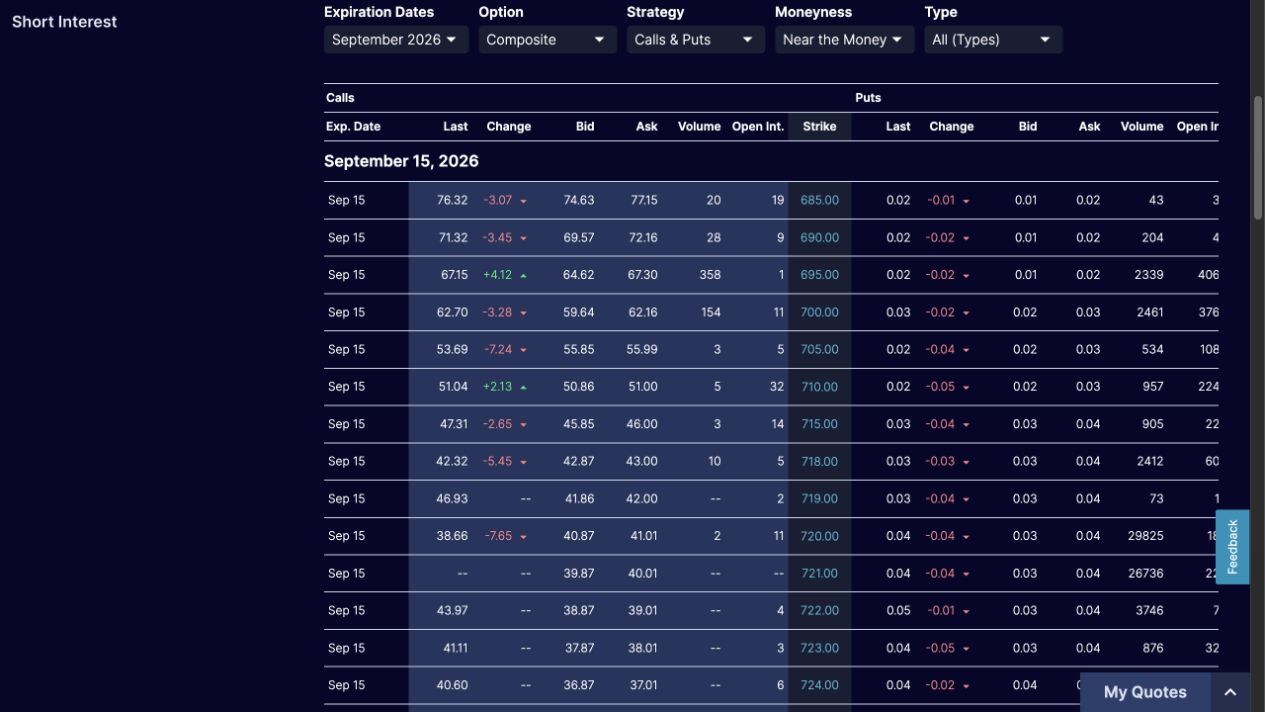
The 710 row shows a call bid/ask of 50.86/51.00 and a put bid/ask of 0.02/0.03. Both expire September 15.
Use the page’s $760.88 SPY reference price. The following decomposition uses the displayed ask, so it describes the premium on the buying side rather than an old last trade. All amounts are per share.
| September 15 contract | Position relative to SPY | Ask | Intrinsic value | Ask minus intrinsic |
|---|---|---|---|---|
| 710 Call | Deep ITM | $51.00 | $50.88 | $0.12 |
| 760 Call | Slightly ITM; near the money | $2.51 | $0.88 | $1.63 |
| 765 Call | OTM | $0.43 | $0 | $0.43 |
| 710 Put | Deep OTM | $0.03 | $0 | $0.03 |
| 765 Put | ITM | $4.56 | $4.12 | $0.44 |
Calculated from the Nasdaq screen, using $760.88 throughout. Individual quote timestamps are not shown beside these bid/ask fields, so the residuals are illustrative estimates of time value, not verified simultaneous valuations. They include the effect of using the ask rather than a midpoint.
For the 710 Call, buying SPY at $710 when it is worth $760.88 already has $50.88 of economic value. Almost the entire $51 ask pays for that existing value. A large premium does not necessarily mean a large payment for future uncertainty.
For the 765 Call, immediate exercise provides no advantage: buying in the market would cost less than exercising. Its $0.43 premium is entirely time value at this reference price. It can still become valuable before expiration.
The 710 Put is much farther out of the money. SPY would need to fall $50.88—about 6.7%—just to reach its strike. Its $0.03 ask is small because the remaining opportunity is remote, not because the contract is necessarily a bargain. The same 710 strike is deep ITM for the call and deep OTM for the put.
The 760 Call is technically ITM, although traders may loosely call it ATM because it is close to SPY. Exact ATM means stock price equals strike. “Deep” has no universal dollar cutoff: distance matters in relation to volatility and time remaining. A $10 gap with hours left is different from a $10 gap with a year left.
Hold the strike fixed; change the expiration
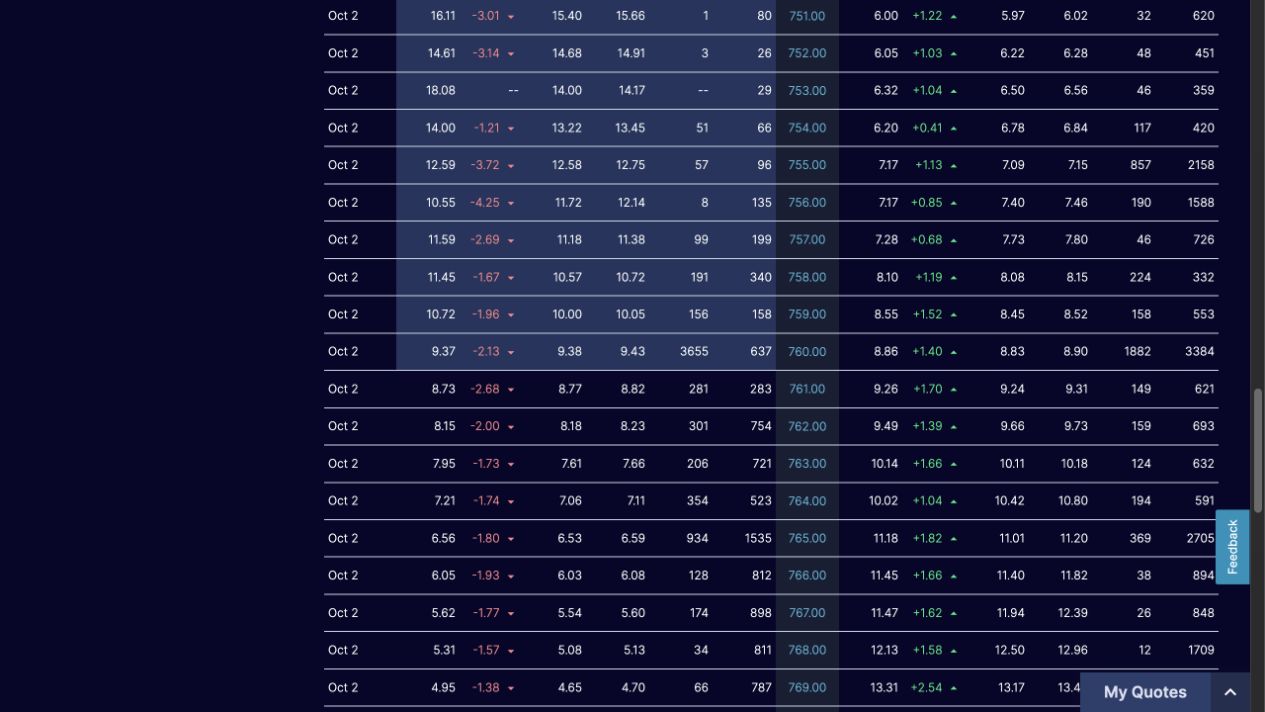
Nasdaq, October filter, October 2 rows. This is a different maturity observed during the same browsing session, not a historical screenshot taken on October 2.
| 760 Call | September 15 expiration | October 2 expiration |
|---|---|---|
| Bid / ask | $2.49 / $2.51 | $9.38 / $9.43 |
| Intrinsic at SPY $760.88 | $0.88 | $0.88 |
| Ask minus intrinsic | $1.63 | $8.55 |
The right to buy at $760 has the same immediate exercise value in both rows. The October contract has a much larger premium above that value. Its holder has more time for a favorable move, including opportunities after the September contract has ceased to exist.
The extra $6.92 per share is a price difference between two maturities. It is not a measurement of how much the October option will lose over the next 17 days. The contracts can embed different volatility, dividend, and financing assumptions, and the underlying price will not necessarily stand still.
This is the market counterpart of Figure 1-3: compare maturities while keeping the strike fixed. To measure how one contract actually changes over time, its own quotes would need to be recorded at multiple observation times.
Time value also contains a price for uncertainty
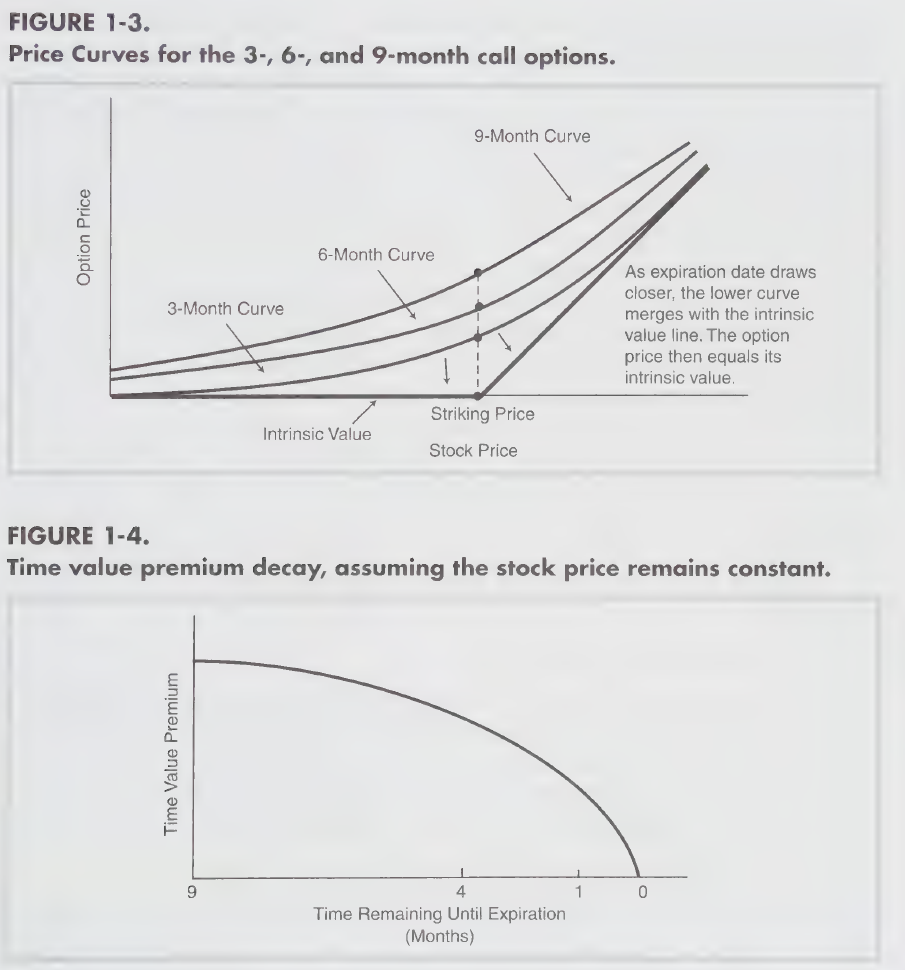
Figure 1-3 compares maturities at the same strike. Figure 1-4 holds the stock price constant and illustrates non-linear time decay. They explain why buying extra time costs money and why decay need not be equal each day.
For near-the-money options close to expiration, small underlying moves can cause sharp changes in exposure. “Less premium left” does not mean that the position becomes quiet.
The book’s term time value can obscure another influence: implied volatility (IV). IV is inferred from option prices through a pricing model. It expresses the volatility embedded in those prices, not the probability that the stock will rise. A high IV is not a bullish signal.
Case: a good earnings report, a losing call
Schwab gives the following hypothetical, not historical, example:
| Before earnings | After earnings | |
|---|---|---|
| Stock price | $100 | $105 |
| Call strike | $100 | $100 |
| Call premium | $7 | $6 |
| Intrinsic value | $0 | $5 |
| Time value | $7 | $1 |
The stock rises 5%, but the call loses $100 per standard contract. Increased intrinsic value is more than offset by a drop in extrinsic value as uncertainty resolves and time passes. Schwab: IV crush example
The question before buying was therefore more demanding than “Will earnings be good?” It was whether the resulting stock move and remaining option value would justify the premium already paid.
This does not make selling before earnings automatically attractive. A sufficiently large stock move can overwhelm the benefit of falling IV.
Exercise: the contract can turn into a different position
The book’s distinction between a right and an obligation becomes concrete at exercise. A call holder buys the underlying; an assigned call writer delivers it. A put holder sells; an assigned put writer buys.
SPY and SPX are not interchangeable contracts
| Feature | SPY options | SPX options |
|---|---|---|
| Underlying | An ETF | The S&P 500 index |
| Exercise style | American; early exercise is possible | European; exercise at expiration |
| Settlement | Delivery of ETF shares | Cash |
| Position after settlement | Can leave a stock holding or short stock position | No delivery of index shares |
These distinctions appear in Cboe’s product comparison; current SPX specifications also distinguish A.M. and P.M. settlement. The exact series matters. Cboe comparison, SPX product details
Hypothetical extension of the SPY example: if the 760 call is exercised, the holder buys 100 shares for $76,000. If those shares subsequently fall by $5, the stock position loses another $500. The original premium cap described the option position; exercise created a new exposure.
Anticipating assignment
The holder instructs a broker to exercise. OCC allocates the exercise to a clearing member with a short position; that firm allocates it to a customer under its assignment procedure. The assigned writer need not be the original seller to that holder. These are three situations to watch, not three conditions that must be met before assignment is possible.
1. In the money at expiration
Expiring equity options generally enter OCC’s exercise-by-exception process when at least $0.01 ITM, unless contrary instructions are submitted. Broker procedures and deadlines matter. Expect assignment on an ITM short call, but do not treat it as certain—especially near the strike, where after-hours moves can affect exercise decisions.
2. Before expiration: a discount to intrinsic value
Here, parity means option price equals intrinsic value. It does not mean “out of the money” and is distinct from put–call parity. A discount means price is below intrinsic value.
The book’s hypothetical example uses a $50 stock bid, a $40 strike, and a $9.80 call ask:
- Buy one call for $980.
- Sell short 100 shares at $50, receiving $5,000.
- Exercise the call, paying $4,000 for shares that cover the short.
The locked gross difference is $20, provided both market legs execute at those prices and exercise is available. Fees, financing, borrow availability, and operational constraints still matter. Buying the call and waiting for stock delivery before selling would leave price risk; exercise and settlement are not an instantaneous exchange trade.
The Nasdaq 710 Call illustrates the distinction. Against the $760.88 reference price, intrinsic value is $50.88. Its $50.86 bid looks discounted, but its $51.00 ask is above intrinsic. A buyer cannot purchase at the bid merely because it is displayed. The quote timestamps also need checking.
This remains a useful test today. The screenshots establish no executable discount, and provide no evidence for a claim that such opportunities have “almost disappeared.”
3. Before the ex-dividend date
An ITM call with little remaining time value deserves attention before the ex-date: exercising can obtain shares and dividend entitlement. Broker guidance treats dividends exceeding remaining time value as a warning sign, not a guaranteed assignment rule.
The book immediately tests the “free dividend” idea: stock $50, strike $40, call $10.25, dividend $1. Buying and exercising costs $50.25. If the stock opens ex-dividend at $49, selling it and receiving $1 recovers only $50: a $0.25 loss per share.
Dividend capture must be weighed against forgone option value, paying the strike early, and trading costs. The formula “dividend > time value + put price” is not a general exercise rule; nor is there a universal 90–99% assignment probability.
A further modern consideration is hard-to-borrow stock: exercising a call may help a holder cover expensive short stock. That incentive depends on the holder’s position and costs.
For the writer: buying to close before assignment removes the short obligation; buying afterward cannot undo it. Assignment converts existing option exposure into delivery or stock exposure—it does not create the entire ITM loss from nothing. A covered writer delivers shares; an uncovered writer may be left short stock, subject to broker requirements. Early assignment applies to American-style contracts such as SPY; SPX does not permit early exercise.
The screen’s price is not necessarily the trade’s price
Return to the September 15, 760 Call: Last 2.49, Bid 2.49, Ask 2.51, Volume 53,754, Open Interest 1,004.
- Last: a past transaction, which can be stale.
- Bid / ask: quoted buying and selling prices, subject to size, timing, and availability. Here the midpoint is $2.50; that is a calculation, not a promised fill.
- Volume: contracts traded during the reported session. A contract can trade repeatedly.
- Open interest: outstanding contracts, generally reported from a clearing cycle rather than updated with each trade.
Volume exceeding open interest does not mean the data are inconsistent. It also does not mean that all 53,754 contracts were newly opened bullish bets. Every trade has a buyer and a seller, and the volume field does not identify whether either side was opening or closing.
The deep ITM 710 Call makes the stale-price issue visible: its last is $51.04, while the displayed ask is $51.00. Those numbers need not come from the same instant. For the calculations above, using the current displayed bid/ask is more informative than treating every last trade as a simultaneous valuation.
Even a valid two-sided quote has a spread. Hypothetically, buying at a $2.50 ask and immediately selling at a $2.40 bid loses $10 per standard contract before fees, with no stock movement required. A midpoint mark of $2.45 would hide half of that round-trip cost.
A limit order controls the acceptable execution price, but may not fill. A market order prioritizes execution without fixing the price. This is why the book’s order-entry section belongs beside the payoff analysis.
Finish with the payoff—not just the strike
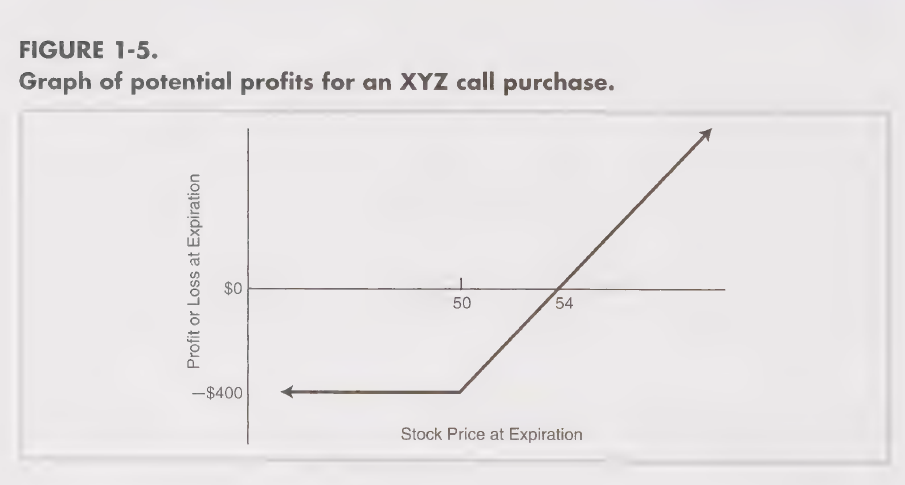
The book uses a 50 call bought for $4: the bend is at 50, while break-even is at 54.
Apply the same logic to the real contract. Assume a purchase at the observed $2.49 last price for illustration; this is not a claimed fill or available ask.
Expiration P/L = [max(SPY at expiration − $760, 0) − $2.49] × 100
| Hypothetical SPY price at expiration | Option value | P/L before fees |
|---|---|---|
| $758 | $0 | −$249 |
| $760 | $0 | −$249 |
| $761 | $100 | −$149 |
| $762.49 | $249 | $0 |
| $765 | $500 | +$251 |
At $761 the call is in the money, but the trade still loses money. $760 is the strike; $762.49 is the expiration break-even under the assumed purchase price.
Before expiration, the call could be sold at a profit below that break-even stock price if enough time value remained. After exercise, continued stock exposure needs its own analysis.